A Thousand Splendid Suns, Khalid Hosseini

Like in his debut novel ‘The Kite Runner’[1], ‘A Thousand Splendid Suns’[2], which was published in 2007, is set during a time of huge turmoil for Afghanistan; between the 1960’s to the early 2000s. In this story, Hosseini tells the movingstory of two women, rather than men, and how this turmoil affects their lives during and after the reign of the Taliban as well as the Soviet Invasion. You see ‘harami’ girl, Mariam, forced into a loveless marriage with an abusive Rasheed and then, nearly two decades later, the almost maternal relationship she forms with young Laila.

Hosseini was born in Kabul, Afghanistan but left with his family in 1976 at the age of eleven, by 1990 their plans to return home were averted; they were faced with a country that had just been brutally overthrown and invaded by Soviets. Being out of the country he may not have experienced the extreme unrest that Mariam and Laila do first hand but he does know what it feels like to see your home be completely disrupted. Perhaps it is this experience and understanding that gave him the ability to accurately and effectively portray the inspiring lives of Mariam and Laila with such sensitivity. 

Although Hosseini’s characters can be a bit simplisitc; they are either heinous or unflawed and can do no wrong, he manages to make the heroic ones really endearing and loveable. He does this by using a descriptive and explanatory style, which almost makes the reader feel as though they are living the characters’ situation, even the readers who have never experienced anything as disturbing as what Mariam and Laila do. The descriptive tone also helps the reader to place themselves in the book’s intense environments. Feeling like you’re in the book’s setting and comprehending how the protagonists feel helps to form a really strong bond between the reader and the characters evidently evoking feelings of compassion and sympathy when things go badly for them. You deeply care about what happens to the characters which is why the ending is so heartbreaking.  Although the story is tragic, the distressing tone is not exaggerated so much that the story becomes entirely painful the whole way through; it does also have fundamental moments of love, hope and beauty.  
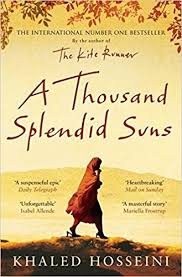
A ‘Thousand Splendid Suns’ not only tells a beautiful story, but it also opened my eyes to a chaotic history I, shamefully, knew very little about previously. Particularly enlightening me to how this chaos affected women, it is undoubtfully up there as one of my favourite books and is a humbling story I will return to many times. 


Rupi Kaur

Rupi Kaur, a top ten Sunday Times-best selling poet, started by sharing her poems on social media.Despite cultivating 3.6 million followers on Instagram and releasing two bestselling collections of poetry; ‘milk and honey’ and ‘the sun and her flowers’, responses to Kaur’s work are very conflicted; some praise her ‘uncomplicated and concise’ style whilst others slate her ‘artless’ poems.

.

.

.

.

.

She touches on many themes in her poems including relationships, heartbreak and racismbut one prevailing theme of many of the Canadian poet’s works is feminism. Take ‘what’s the greatest lesson a woman should learn? for example;

In ‘Feminist, Female, Feminine’a feminist is said to be “committed to the struggle against patriarchy and sexism”.In this poem, Kaur undeniably defies the patriarchy by empowering women and ‘exposing the way in which male dominance over females constitutes ‘perhaps the most pervasive ideology of our culture’”. She accuses ‘the world” for stripping females of their self-worth and thrusting on them the belief that she needs anything more than herself.

In the poem she empowers women by saying that they have “everything” they need. This empowerment is further highlighted/executed/ by Kaur’s use of enjambment; by ending the line with the word ‘everything’and continuing the sentence on another line creates a pause whichplaces emphasis on the word and gives it more weight. By applying this additional stress, it causes the reader to think about just how much “everything” is and therefore how strong and independent women are.

Another feminist attitude Kaur explores is the idea of women standing up for their rights together. She unites women in this poem with the use of nouns and pronouns. Rather than asking “what’s the greatest lesson [women] should learn?” she asks “what’s the greatest lesson a woman should learn?”. She also says “she” and “her” as if this poem is only relevant to one woman when it is, in fact, relevant to all women. By referring to all women as “she”, “her” and “a woman” it makes them one. With this unity comes strength and power.

The poem is also presented with an illustration, also done in a very simplistic style. It works well with the poem and visually represents women’s empowerment well as the drawing of the nude woman almost merges with the river and trees. This again represents unity but rather than unifying all women it unifies women with nature, suggesting strength. It paired with the nudity, which represents purity and being stripped back to basics, also shows that she doesn’t need anything that has been put there by man; that her and the natural world will suffice. The nudity also portrays vulnerability, showcasing how much women are oppressed by the patriarchy and stripped of their self- worth. 

Whether you like her poems or not, there’s no denying that Kaur is shining a light on the inequality of sexes and therefore playing an important role in creating a fairer society. 

Seven

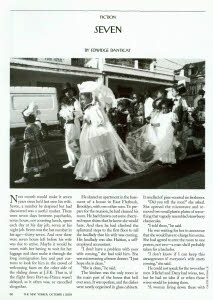
“Seven”, a short story written by Edwidge Danticat, portrays the life of a working class Haitian man who, leaving his wife behind, has immigrated to Brooklyn, NYC in pursuit of a better life. He works two jobs; a day shift and a night shift and resides in a single room within a basement with two other men. The simple environment in which he lives is mirrored by the simple and to the point style in which Danticat writes. 

Seven years after leaving Haiti and his wife, his spouse has just arrived at JFK airport. It is the first time that they will have seen each other since his departure. Danticat presents us with a multitude of things that the man has sacrificed in order to enhance his economic position. The character is a prime example of the ways in which Karl Marx believes Capitalism has forced society to hold economy in the heart of our lives. 

He represents a society which has been led, by capitalism, to believe a set of ideologies. Examples of these ideologies include: it being thought as sinful to take more than a few weeks off a year, and that the number of belongings we accumulate will have a direct correlation on one’s happiness. 

The character in this story has left Haiti, his home, to spend the past seven years working 14 hours a day, 5 days a week doing janitorial work and living in a basement away from his wife all in order to save for an apartment and, ultimately, a house”. He has sacrificed all this and ultimately, the story ends with “a silence [that] come[s] over them”

In “Marxism and literary criticism”, Eagleton says “Art, then, is for Marxism […] an element […] which ensures that the situation in which one social class has power over the others is seen by most members of the society as natural, or not seen at all”. This piece of writing can be excluded from this description of art for it presents us with a member of the working class who is left with nothing but “silence”. Rather than just accepting that the protagonist works extremely hard for very little money and with very little time for pleasure, this ending encourages the reader to think about how unjust this is. By highlighting this injustice, Danticat has done the opposite of ensuring the above and instead made the fact that one class holds all the power and the majority of the wealth abnormal.

“Seven” is an extremely eye-opening story that really makes you think about the society in which we live. Take a look at the article here, it’s well worth a read. 

Bronwyn Lee; a self-portrait

It was really interesting to meet Bron and get to chat with her about the process of her display for the show that is being held in March. The final piece is leaning towards being an abstract self-portrait set in front of a black and white background of screen-printed pill packets. 

Bron says her decision to try portraits stems from always being “interested in and inspired by people”. Before concluding on doing a self-portrait Bron began by doing a painting of a photo of her dad when he was younger. This was done using bright paints and on quite a large scale which is really effective. The piece is a good representation of her ability to capture emotion. However, it is the next attempts that her skills at this are really demonstrated.

After finishing the portrait of her father, the decision to make the final piece more personal was made and so she moved onto self-portraits. These self-portraits hold so much emotion which could be due to a multitude of factors; it was at this point that Bron decided she didn’t enjoy painting from photos as much as she enjoyed painting the real thing. She believes that photos do not hold the same amount of feelings and emotion as a real person does and this definitely comes across when comparing the piece of her father and the self- portraits which were painted from her reflection in a mirror. Another factor is that, perhaps, it is easier to paint emotions when you are the one actually feeling them.

Bron’s 2nd self portrait.

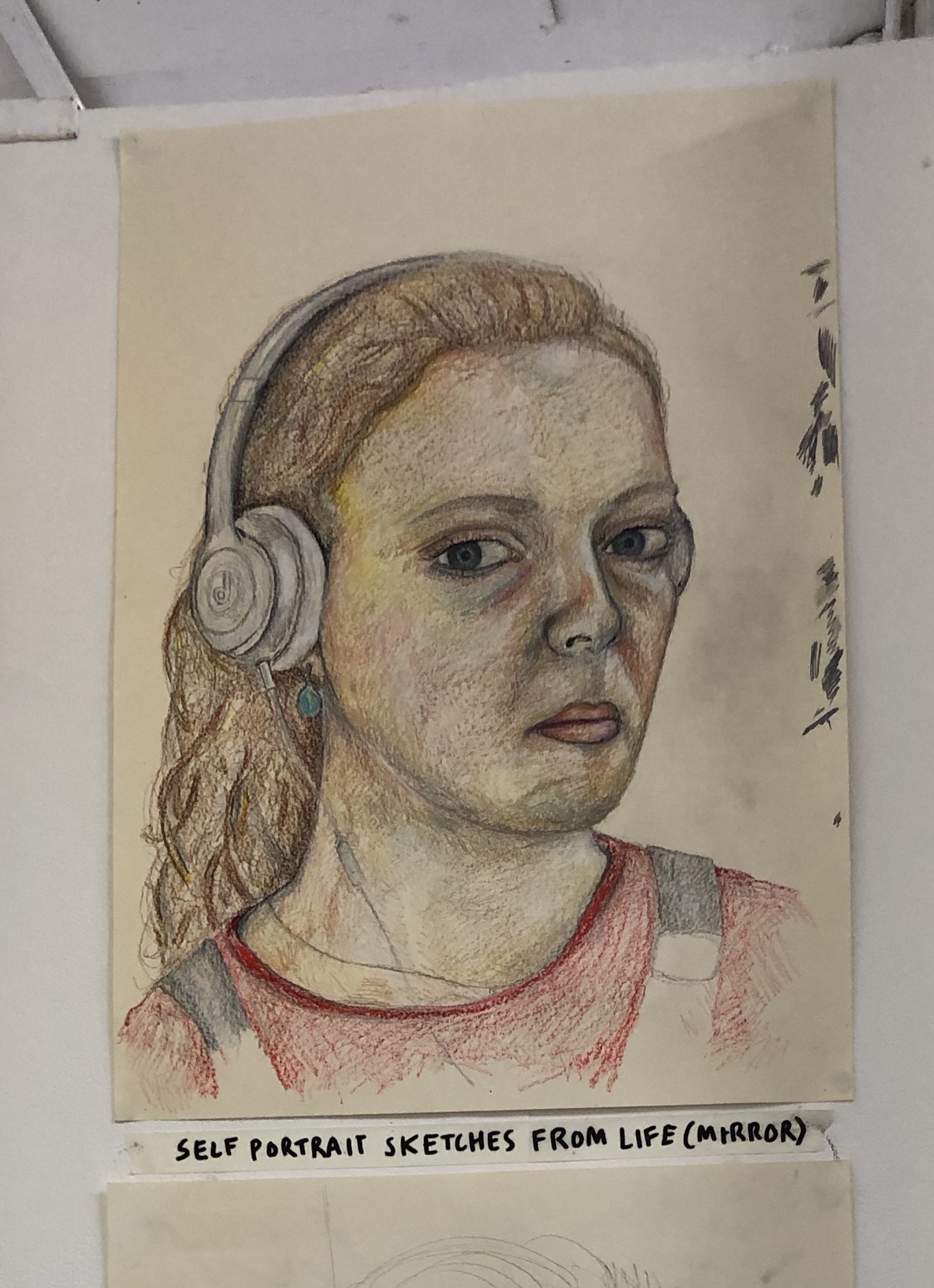
She has done three self-portraits so far. The first two were done with paints. Her first attempt (right) has been done in quite a representational style. I like it a lot however it does not represent her as accurately as the second (above) which has been done more abstractly. Bron has used very short, thick and straight brush strokes in this piece which she says “complete” the piece for her. I really love the way these strokes have captured the many different tones of blonde and brown as well as the waves and curls in her hair. It’s interesting that this abstract technique has captured her hair more successfully than the representational style used in the first piece.   

The third piece (below), which is my favourite, has been done with pencil. This piece holds the most emotion and also evokes multiple questions in the recipient;

  • What is she listening to?
  • Is she looking at me?

Different recipients will also have different questions for they will assume different emotions from her expression; some may see it as stern, others as sad or others as angry. The direct eye contact she is making partnered with her expression make you wonder whether she is annoyed/indignant/sad with you personally. 

Bron’s 3rd self-portrait, done in pencil.

A final touch that is really effective in personalising her exhibition display is the addition of the pill packet background. Bron has had to take these tablets every day for years and so are a big part of her life. By adding them faintly in the background they create another level of personality as well as making the background behind the portraits far more interesting without detracting from the main piece.

The screen printed pill packet background.

It’s going to be a deeply personal display that leaves the viewer wondering and with lots of questions. I’m looking forward to seeing the final pieces in the exhibition which commences on the 18th of March at The Poly, 24 Church St, Falmouth and will be on for a week.


Feeding China

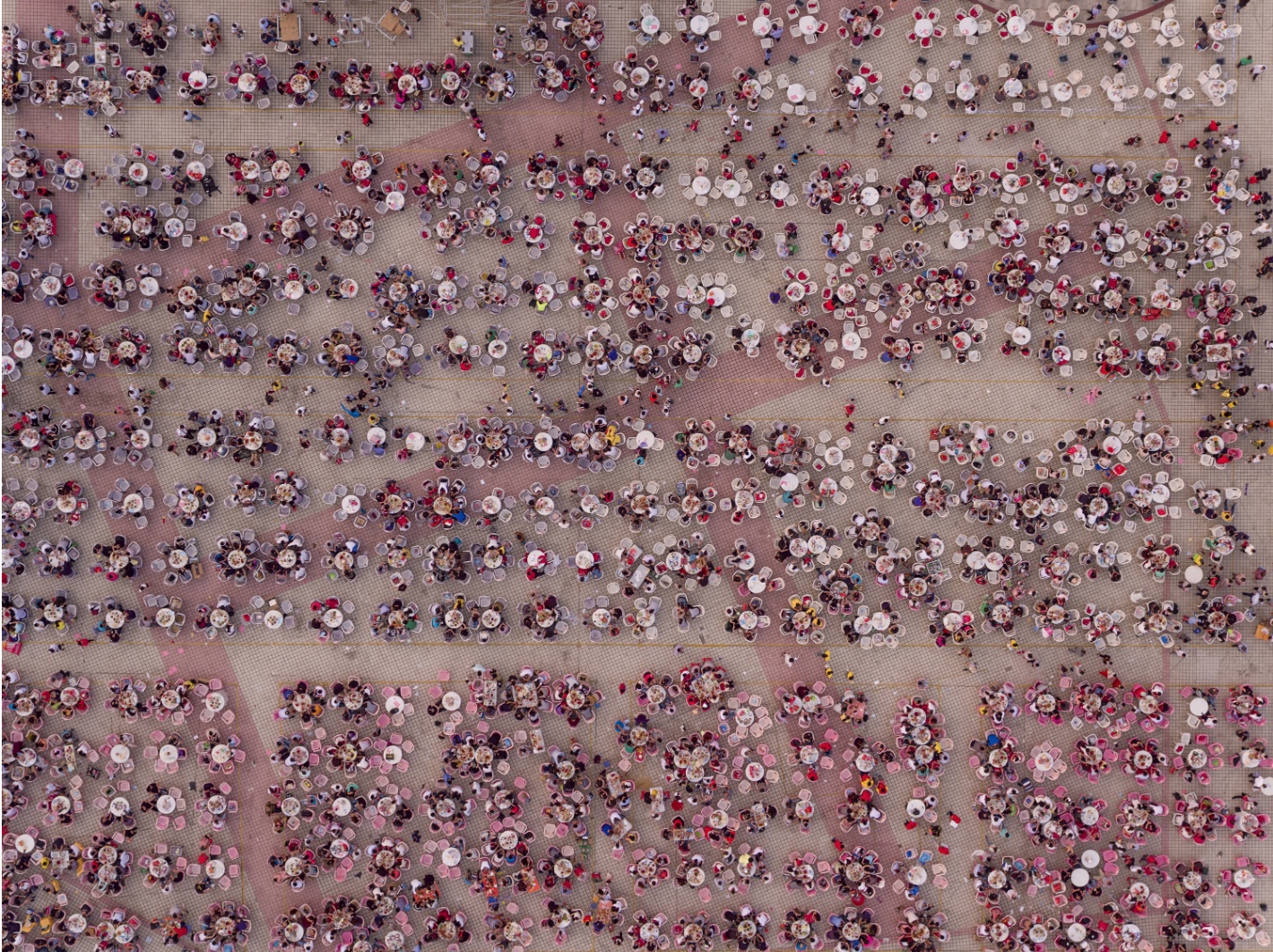
This Steinmetz image, taken from a story of his images reflecting ‘Contemporary Issues’, is of a fragment of tens of thousands of people celebrating at an annual crayfish festival in Jiangsu, China. The photo was taken for National Geographic and has been used in an article discussing how China plans to feed its evergrowing population which currently stands at 1.4 billion.

The article examines how “China is grappling with a daunting conundrum: how to feed nearly one-fifth of the world’s population with less than one-tenth of its farmland, while adapting to changing tastes”. The Chinese’s demand for meat, dairy and processed food has increased drastically since the ’90s. This is not only due to the growing population but also to the increase in wealth as well as progressions that have been made in technology. This growing demand could be a threat to the people of China if a way to meet it is not found. This photo encapsulates the threat that this problem creates really well in many ways.

One way in which Steinmetz has done this is simply by capturing an area where the colour red is particularly prominent. Due to the connotations that the colour holds, a sense of warning and danger is created. This dangerous atmosphere is surrounding thousands of people eating and so suggests that this act is the cause of danger.

The birdseye view allows for a lot of people to be pictured which not only gives a good representation of how large the population of China is and how vast the demand for food is but also how many people are at threat because of this demand. When you visit the article online there is a video taken from the same angle and place as the photo. The video begins extremely zoomed in on some of the tables and gradually zooms out, quickly showing more and more people. This is extremely effective in showing just how rapidly the population and demand for food are growing. Which subsequently shows how fast the problem is growing too.

Another important aspect of the photo that adds to its powerful message is the fact that the people pictured are (most likely) oblivious to two things; the amount of red around them and the fact that they are being photographed. This unawareness perhaps implies that they are also ignorant to the problems that we are facing which is possibly the reason Steinmetz decided to tell this particular story; to make people conscious of the consequences that their habits hold.

This photo is not only, in my humble opinion, very eye-catching, aesthetically pleasing and interesting to look at but also extremely powerful and influential due to the message it conveys. It’s unsurprising that it received 2nd prize in its category from the World Press Photo Awards.

Eat Pray Love

Whilst I was planning my trip to Asia a couple of years ago the number of images of idyllic beaches with crystal clear water, like this one, seemed endless. They were even more alluring than usual because at this time I was working as a Testing Technician in a software house in order to save up for the trip. Making sure software used for operating train ticket machines did as it should for 8 hours a day, 5 days a week didn’t quite compare to lounging on a beach and although I knew I would eventually be basking in that sun and feeling the fine, white sand in between my toes, I needed something to satisfy my craving for some sunshine and the sea.

Although my salty craving was the kind that only the ocean can completely fulfil, I looked to Goodreads for something that could perhaps attempt to tide me over… Scrolling through the travel section I came across Elizabeth Gilbert’s ‘Eat Pray Love”. I recognised the cover from my mum’s collection but had never read it. Seeing that it was set in Italy, India and Indonesia I thought it had as good a chance as any to help lessen my yearning.

The story gives a true, first-person account of an unhappily married woman who, after years of confusion and dissatisfaction, realises she has lost herself. After going through a divorce, a bout of depression and another failed relationship, she embarks on a year-long journey of rediscovery.

The journey begins in Italy’s capital; Rome, where she studies the art of pleasure through the act of eating (eat). After perfecting the art and “gaining the happiest 23 pounds of her life” she moves on to India where a few months are spent strictly exploring and deepening her spirituality (pray). And finally, she finishes the adventure in Bali, Indonesia with the aim of finding balance. Whilst there she also finds love (love).

Although this book may not be a ground-breaking feminist or political novel and it may not delve into particularly deep, meaningful or risky themes or topics and although Gilbert is perhaps slightly self- indulgent, I must, with slight embarrassment, admit to fitting the stereotypical female reader cliché and say I still found myself unable to put it down.

Her descriptions create a setting of utmost beauty and you can’t deny that Gilbert possesses the ability to exquisitely paint a scene and place a reader within it. She also has a good deal of talent when it comes to making you feel like you really know her. I couldn’t help but relate to her and I think this is due to how well she conveys her thoughts and feelings onto paper. Her relatability makes for a very loveable protagonist.

Sometimes, anything even slightly more intense than Eat Pray Love is too intense and all you want is an easy, light-hearted and sunny book to act as an escape or temporary fix. The beautiful setting, acts of indulgence and inspiring protagonist all make for exactly this.